The Complete Guide to Pokémon TCG Set Symbols and Rarity
A practical guide to identifying Pokémon cards using set symbols, expansion codes, collector numbers, rarity marks, regulation marks, and foil treatments.

Updated August 2026
A few small details can identify almost any Pokémon card
The tiny code, number, and symbol near the bottom of a card tell you far more than the artwork alone. Once you know what each detail means, identifying the exact printing becomes much easier.
Fastest identification method
1
Read the expansion code
2
Check the collector number
3
Confirm the rarity mark
A Pokémon card contains much more information than its name and artwork.
Near the bottom edge, you can usually find an expansion identifier, collector number, rarity mark, copyright line, language information, and sometimes a regulation mark.
Those details help you tell similar cards apart. That matters because the same Pokémon can appear in several sets, with similar artwork, different foil treatments, and completely different values.
This guide covers the full identification process, from the original Base Set to the current Mega Evolution series.
The Six Details to Check First
You do not need to memorize every set symbol ever printed. Start with these six details.
01
Start here
Card name
Start with the Pokémon, Trainer, or Energy name.
02
Expansion
Set identifier
Look for a classic symbol or a modern printed code.
03
Exact card
Collector number
A number such as 025/165 identifies the card inside its set.
04
Card tier
Rarity mark
The circle, diamond, star, or modern symbol shows the official rarity.
05
Surface
Foil treatment
Check whether the card is regular, reverse foil, holofoil, or textured.
06
Final check
Language and condition
Language, print version, and wear can all affect identification and value.
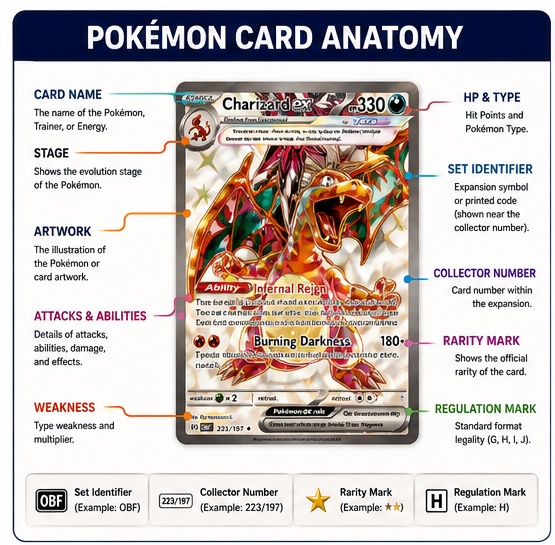
The exact position changes between eras, but the key details usually sit near the bottom edge.
What Is a Pokémon TCG Set Symbol?
A set symbol tells you which expansion a card belongs to.
Older expansions normally used a small themed picture. Jungle used a flower. Fossil used a fossil footprint. Team Rocket used a large letter R.
Modern cards often use a short printed expansion code instead. The code and collector number are usually the quickest way to identify a recent card.
| Expansion | Printed Code |
|---|---|
| Scarlet and Violet | SVI |
| Paldea Evolved | PAL |
| Obsidian Flames | OBF |
| Pokémon 151 | MEW |
| Paldean Fates | PAF |
| Twilight Masquerade | TWM |
| Surging Sparks | SSP |
| Journey Together | JTG |
| Mega Evolution | MEG |
A card marked MEW 006/165 belongs to Pokémon 151 and is card number 6 in the main set.
i
Use all three details when searching
Search for the card name, expansion code, and collector number together. This avoids confusion between reprints, promotional cards, and cards with similar artwork.
Classic Set Symbols
The earliest expansions used memorable visual symbols rather than printed codes.
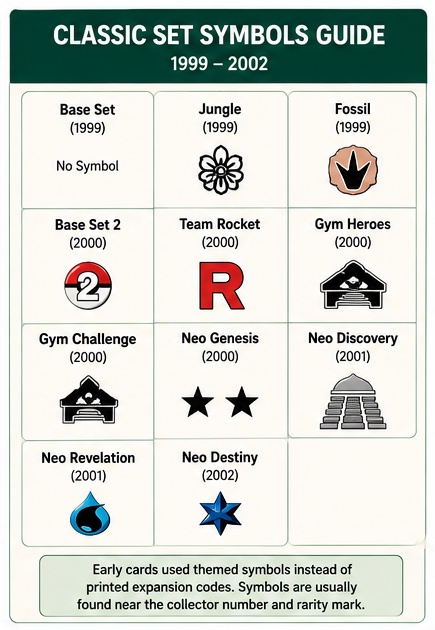
Classic symbols normally appear close to the collector number and rarity mark.
Original and Neo Eras
| Expansion | Release Year | Identifier |
|---|---|---|
| Base Set | 1999 | No expansion symbol |
| Jungle | 1999 | Flower |
| Fossil | 1999 | Fossil footprint |
| Base Set 2 | 2000 | Number 2 with a Poké Ball |
| Team Rocket | 2000 | Letter R |
| Gym Heroes | 2000 | Gym style emblem |
| Gym Challenge | 2000 | Modified gym emblem |
| Neo Genesis | 2000 | Two connected stars |
| Neo Discovery | 2001 | Ruins style structure |
| Neo Revelation | 2001 | Eye or water drop style symbol |
| Neo Destiny | 2002 | Triple star style symbol |
Why Base Set Has No Symbol
The original English Base Set normally has no expansion symbol.
That is useful, but it does not mean every card without a symbol is automatically from Base Set. Promotional cards, oversized cards, special products, and unusual printings can follow different rules.
Check the collector number, copyright date, card layout, and artwork before deciding.
First Edition Is a Separate Detail
A First Edition stamp identifies an early print run. It does not identify the expansion.
A card can have all of these at the same time:
- A First Edition stamp
- An expansion symbol
- A rarity mark
- A collector number
Each one tells you something different.
How Card Identification Changed Over Time
You do not need to learn every logo. It is more useful to understand how the identification system changed between eras.
| Era | Approximate Years | Common Identification Style |
|---|---|---|
| Original and Neo | 1999 to 2002 | Small themed picture |
| e Card and EX | 2002 to 2007 | Expansion picture with collector number |
| Diamond and Pearl | 2007 to 2009 | Stylized themed symbol |
| Platinum | 2009 to 2010 | Stylized themed symbol |
| HeartGold and SoulSilver | 2010 to 2011 | Symbol near the collector number |
| Black and White | 2011 to 2013 | Symbol and collector number |
| XY | 2014 to 2016 | Symbol with a modern card layout |
| Sun and Moon | 2017 to 2019 | Symbol, collector number, and regulation information |
| Sword and Shield | 2020 to 2023 | Printed codes became especially useful |
| Scarlet and Violet | 2023 to 2025 | Code, number, rarity mark, and regulation mark |
| Mega Evolution | 2025 to present | Modern code and rarity system |
The Mega Evolution Series
The Mega Evolution series began in 2025 and brought Mega Evolution Pokémon back to the physical Pokémon TCG.
As of August 2026, the main English expansions include:
| Expansion | Release Period |
|---|---|
| Mega Evolution | September 2025 |
| Mega Evolution: Phantasmal Flames | November 2025 |
| Mega Evolution: Ascended Heroes | January 2026 |
| Mega Evolution: Perfect Order | March 2026 |
| Mega Evolution: Chaos Rising | May 2026 |
| Mega Evolution: Pitch Black | July 2026 |
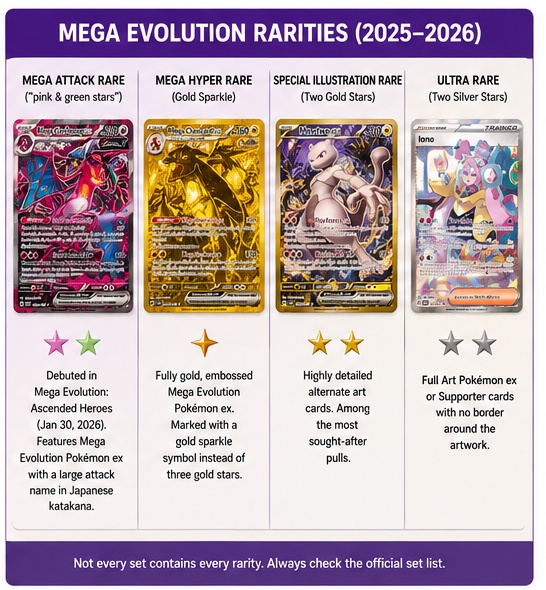
Ascended Heroes also introduced Mega Attack Rare, a rarity built around dramatic Mega Evolution attack artwork.
Collector note
Artwork alone is not enough
Promotional cards and expansion cards can feature the same Pokémon in similar styles. Confirm the expansion code, collector number, and rarity mark before naming the exact card.
Understanding Pokémon Card Rarity Symbols
The rarity mark tells you how a card is classified inside its expansion.
It does not guarantee a certain price. Character popularity, artwork, condition, supply, competitive use, and current demand often matter just as much.
Traditional Rarity Marks
| Symbol | Official Rarity | General Meaning |
|---|---|---|
| ● | Common | Frequently found cards |
| ◆ | Uncommon | Less frequent than Common |
| ★ | Rare | Traditional Rare tier |
| PROMO | Promotional card | Distributed outside normal booster sets |
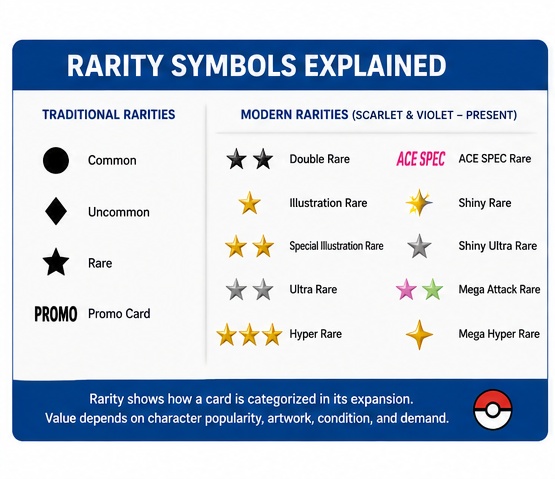
Several modern rarities use stars, so both the number and color matter.
Modern English Rarities
The Scarlet and Violet era introduced a clearer official structure for premium cards. The Mega Evolution series continues much of that system and adds new Mega specific rarities.
| Rarity | Visual Identifier | Typical Card Style |
|---|---|---|
| Common | Black circle | Standard card |
| Uncommon | Black diamond | Standard card |
| Rare | Black star | Rare Pokémon or Trainer |
| Double Rare | Two black stars | Pokémon ex or Mega Evolution Pokémon ex |
| Illustration Rare | One gold star | Full card illustration of a regular Pokémon |
| Ultra Rare | Two silver stars | Full art Pokémon ex or Supporter |
| Special Illustration Rare | Two gold stars | Premium alternate illustration |
| Hyper Rare | Three gold stars | Gold styled card |
| ACE SPEC Rare | Magenta ACE SPEC mark | Powerful Trainer or Special Energy card |
| Shiny Rare | Shiny rarity mark | Shiny Pokémon in selected special sets |
| Shiny Ultra Rare | Premium shiny rarity mark | Full art shiny Pokémon ex |
| Mega Attack Rare | Pink and green stars | Mega Evolution card with prominent attack artwork |
| Mega Hyper Rare | Special gold Mega mark | Premium gold Mega Evolution card |
Not every expansion contains every rarity. Check the card list for the specific set before assuming a rarity is available.
What Is a Mega Attack Rare?
Mega Attack Rare cards debuted with Ascended Heroes.
They feature Mega Evolution Pokémon ex with dramatic full card artwork. A major attack name appears prominently in Japanese katakana as part of the design.
The rarity mark uses two pastel stars, normally shown in pink and green.
Do not confuse Mega Attack Rare with:
- Special Illustration Rare
- Ultra Rare
- Mega Hyper Rare
- Promotional Mega Evolution cards
The collector number and rarity mark provide the clearest answer.
What Is a Mega Hyper Rare?
Mega Hyper Rare cards use an elaborate gold presentation connected to Mega Evolution Pokémon ex.
Calling something a gold card is not precise enough. Older expansions also contain gold Trainer cards, gold Energy cards, Hyper Rare cards, and other gold treatments.
Always confirm the expansion, collector number, and rarity mark.
Rarity and Foil Are Not the Same Thing
This is one of the easiest mistakes to make.
Regular Card
A normal card without a special foil treatment.
Holofoil
The artwork area, or another chosen part of the card, has a holographic effect.
Reverse Holofoil
The foil appears outside the main artwork area.
A Common or Uncommon card can be printed as a reverse holofoil while keeping its original rarity.
Textured Card
Some premium cards have a raised pattern that you can feel under careful inspection.
Texture can help with identification, but it is not enough on its own to prove that a card is authentic.
!
Shine does not equal rarity
A shiny card is not automatically rare, expensive, or authentic. Read the printed rarity mark first.
Set Identifier Versus Rarity Mark
These details often sit close together, but they answer different questions.
| Detail | What It Tells You | Example |
|---|---|---|
| Set identifier | Which expansion the card belongs to | MEW |
| Collector number | Which card it is inside that expansion | 006/165 |
| Rarity mark | Its official rarity tier | One gold star |
| Regulation mark | Its tournament regulation group | G, H, I, or J |
A precise identification looks like this:
Charizard ex, OBF 223/197, Special Illustration Rare
That is much more useful than saying:
The shiny Charizard card
Understanding Collector Numbers
A collector number normally looks like this:
025/198
The first number identifies the card. The second number shows the size of the main numbered set.
Sometimes the first number is higher than the printed set total:
223/197
That normally means the card belongs to the secret portion of the expansion.
It does not automatically make the card valuable. It only tells you where the card sits in the numbering system.
Promotional Numbers
Promotional cards may use codes such as:
- SWSH001
- SVP001
- MEP001
These belong to promotional series rather than a normal booster expansion list.
What Is a Regulation Mark?
Modern cards may show a boxed letter near the bottom.
Examples include:
- G
- H
- I
- J
The regulation mark is mainly used for organized play and format rotation.
It is not:
- A rarity symbol
- A condition grade
- A set symbol
- A print quality rating
Collectors can still use it as another clue when identifying the age and format of a card.
Japanese Pokémon Card Rarity Codes
Japanese cards normally use printed letter codes instead of the traditional English circle, diamond, and star system.
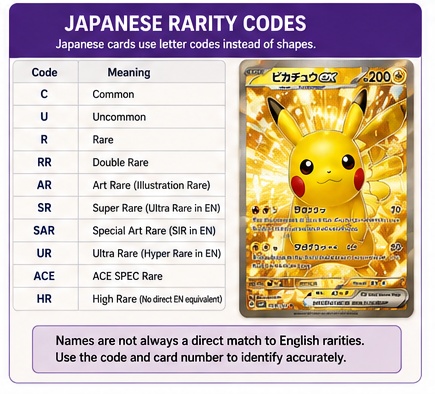
Japanese rarity names do not always match English rarity names directly.
Common Japanese rarity codes include:
| Japanese Code | General Meaning |
|---|---|
| C | Common |
| U | Uncommon |
| R | Rare |
| RR | Double Rare |
| AR | Art Rare |
| SR | Super Rare |
| SAR | Special Art Rare |
| UR | Ultra Rare |
| ACE | ACE SPEC rarity |
Some older sets use different systems, and special products can have unusual markings.
The Translation Trap
A Japanese UR does not necessarily match an English card officially called Ultra Rare.
Japanese SAR is generally closest to the English Special Illustration Rare idea. Japanese AR is generally closest to Illustration Rare.
The safest approach is to compare the collector number and artwork, not only the translated rarity name.
What If a Card Has No Rarity Mark?
A missing rarity mark does not automatically mean the card is valuable.
Possible explanations include:
- It comes from an early expansion with unusual formatting
- It is a promotional card
- It came from a special product
- It is an oversized card
- It belongs to a theme deck or special release
- It is a Japanese or other international printing
- It is counterfeit
- Its rarity is shown through another code
Use the name, artwork, collector number, copyright line, and expansion identifier together.
Common Identification Mistakes
Assuming Every Old Card Is Valuable
Age alone does not create value.
Many older Common and Uncommon cards were printed in large numbers. Exact printing and condition matter much more.
Confusing Reverse Holofoil With High Rarity
Reverse holofoil is a treatment. It does not replace the printed rarity mark.
Ignoring the Collector Number
Different versions of the same Pokémon can share a name and use similar artwork. The collector number prevents many mistakes.
Calling Every Full Art Card an Alternate Art
Collectors use many informal names, including alternate art, full art, secret rare, and character rare.
The official rarity printed on the card is more precise.
Mixing Pokémon TCG Pocket With Physical Cards
Pokémon TCG Pocket uses its own digital rarity system.
Its diamonds, stars, and crowns should not be applied to physical cards.
Using Asking Prices as Real Value
A seller can ask for any amount.
For a realistic estimate, compare completed sales for the same:
- Card
- Expansion
- Collector number
- Language
- Condition
- Grading company and grade, when relevant
How to Check Whether a Card Is Fake
No single test is perfect. Look for several warning signs together:
- Incorrect expansion code
- Wrong collector number
- Missing or incorrect rarity mark
- Spelling mistakes
- Unusual font
- Blurry text or artwork
- Incorrect card dimensions
- Colors that are too dark or washed out
- Flat rainbow foil on a card that should be textured
- Incorrect copyright information
- Details that do not match a trusted card database
CHECK
Never rely on one authenticity test
Compare the printing, texture, dimensions, text, collector number, and expansion details with a verified example. A convincing fake may pass one check and fail several others.
Does Rarity Determine Value?
Rarity is only one part of a card's value.
| Factor | Why It Matters |
|---|---|
| Character popularity | Charizard, Pikachu, Eeveelutions, and other favorites often attract stronger demand |
| Artwork | Popular illustrations may carry a premium |
| Condition | Scratches, whitening, dents, and creases can reduce value sharply |
| Supply | Some cards are harder to find or were printed in lower quantities |
| Expansion popularity | Popular sets attract more collectors |
| Competitive demand | Playable cards can rise while they are useful in tournaments |
| Language | English and Japanese cards can have different markets |
| Grading | A trusted high grade can improve price and liquidity |
| Reprints | A new printing can affect demand for older versions |
Avoid treating permanent price ranges as fact. Card prices can move quickly.
For a specific card, use recent completed sales and compare the exact printing and condition.
Quick Modern Rarity Reference
| Rarity | Identification |
|---|---|
| Common | Black circle |
| Uncommon | Black diamond |
| Rare | Black star |
| Double Rare | Two black stars |
| Illustration Rare | One gold star |
| Ultra Rare | Two silver stars |
| Special Illustration Rare | Two gold stars |
| Hyper Rare | Three gold stars |
| ACE SPEC Rare | Magenta ACE SPEC mark |
| Shiny Rare | Shiny rarity mark |
| Shiny Ultra Rare | Premium shiny rarity mark |
| Mega Attack Rare | Pink and green stars |
| Mega Hyper Rare | Premium gold Mega mark |
Frequently Asked Questions
Where is the set symbol on a Pokémon card?
It is normally near the bottom of the card, close to the collector number and rarity mark.
Older cards often use a themed picture. Modern cards commonly use a printed expansion code.
Where is the rarity mark?
On modern English cards, it is usually near the bottom left beside the expansion code and collector number.
On many older cards, it appears near the bottom right.
What does a black circle mean?
A black circle means Common.
What does a black diamond mean?
A black diamond means Uncommon.
What does a black star mean?
A black star normally means Rare.
What do two black stars mean?
Two black stars mean Double Rare in the modern system. This tier commonly includes Pokémon ex and Mega Evolution Pokémon ex.
What does one gold star mean?
One gold star normally means Illustration Rare.
What do two gold stars mean?
Two gold stars normally mean Special Illustration Rare.
What do three gold stars mean?
Three gold stars normally mean Hyper Rare.
What are the pink and green stars?
They identify Mega Attack Rare cards from the Mega Evolution series.
Is a reverse holofoil card automatically rare?
No. Common, Uncommon, and Rare cards can all receive reverse holofoil treatments.
Why is the card number higher than the set total?
It normally belongs to the secret portion of the set. For example, 223/197 is numbered beyond the main 197 card list.
Does a promotional card have a normal rarity?
Promotional cards usually use a promo identifier instead of the normal booster set rarity structure.
Are Japanese rarity codes the same as English rarities?
Not exactly. The systems are related, but direct translations can be misleading.
Is a missing symbol proof that a card is from Base Set?
No. Promotional cards, oversized cards, special products, and counterfeit cards may also lack a normal set symbol.
What is the fastest way to identify a card?
Search for the name, expansion code, and collector number together.
The Simple Identification Formula
Best search format
Card name + expansion code + collector number
Example: Pikachu MEW 025/165
This combination identifies the exact version more reliably than artwork, shine, or rarity alone.
CollectPoke tools
Found a card you cannot identify?
Search by name, expansion code, or collector number. The more details you enter, the faster you will find the correct printing.
Last updated August 4, 2026. Expansion names and rarity systems can change when new products are released. Confirm unusual cards with the official expansion list or a trusted card database.